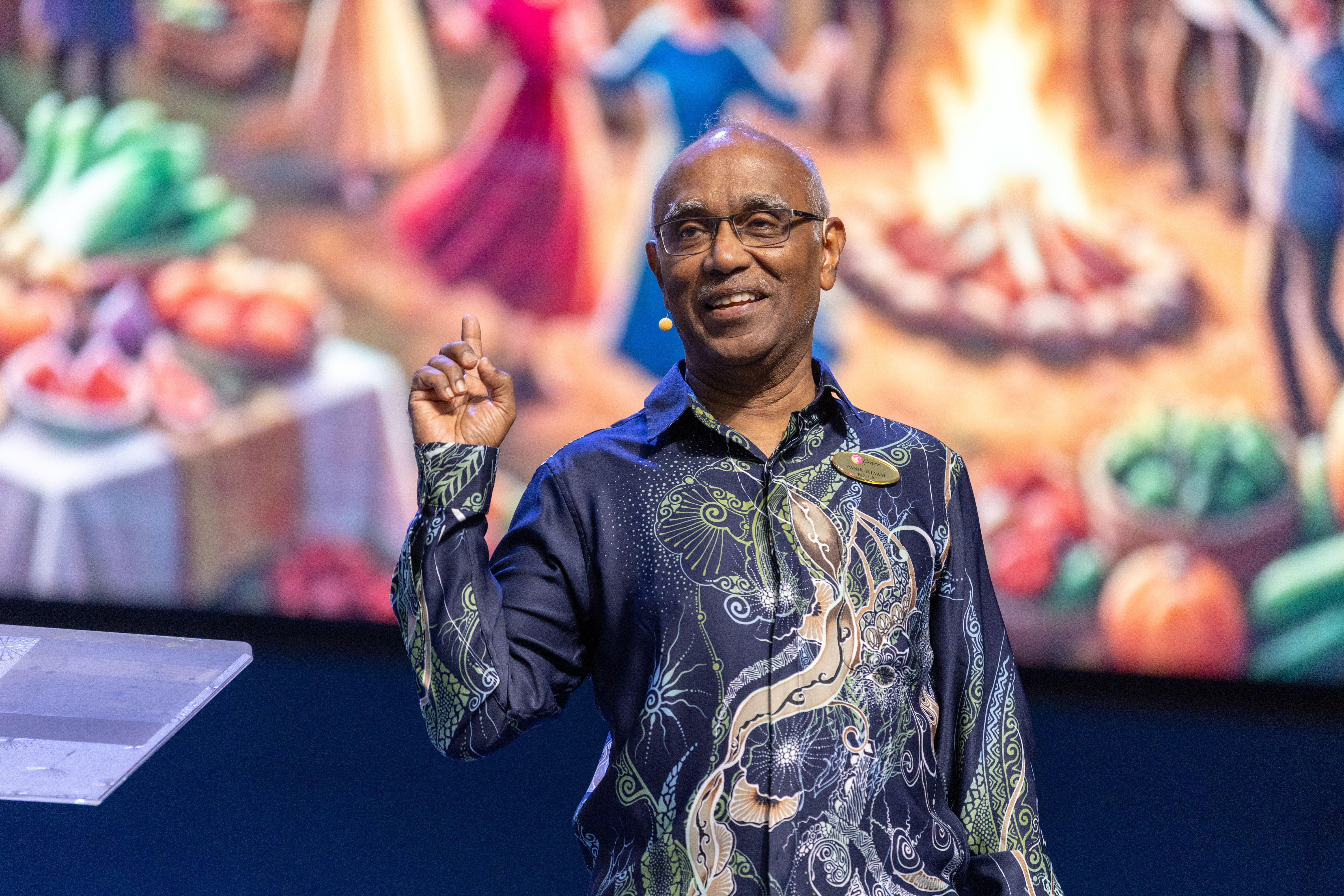
Kingdom Living
by Pastor Panir Rajamany
27 September 2026
Key Texts: Luke 4:18–19 (Isaiah 61); Matthew 4:17; Judges 21:25; Isaiah 6:1; Isaiah 9:6; Genesis 49:8–9; Revelation 5:5–10; Daniel 2; Matthew 5:3–16; Luke 18:9–14; Matthew 6:9–10, 6:33; 2 Corinthians 5:18–20; Romans 12:18; Matthew 7:24–27
Theme: The believer already lives in the kingdom of heaven under a sovereign and everlasting King, and is called to embody the character of that kingdom and to carry its influence into the world through obedience.
A Temporary Tent and an Eternal Kingdom
The Feast of Tabernacles, also known as Sukkot, is a seven-day festival and is described as the most joyful of the feasts Israel kept each year. Its temporary booths recall the forty years in the wilderness, when God was Provider and Protector of His pilgrim people, and the feast also marks the close of the harvest season. The booth is a reminder that life on earth is temporary, just as Paul describes the believer's body as a tent that will one day be folded up as the believer departs for an eternal home. Heaven, however, is not the only destination, for the believer will return to rule with the Lord on this earth during the thousand-year millennial reign.
The feast is a picture that was partially fulfilled when Christ came announcing the kingdom of God, and it will be fulfilled in its fullness during the millennial rule, when nations will gather in Jerusalem to celebrate it. Its value lies in what it symbolises: the presence, provision, and protection of God. It is not meant to lead the believer into adopting Jewish dress or Hebrew worship, which takes the matter further than Scripture requires.
Application:
Hold your earthly life loosely as a temporary tent, and remind yourself daily that you already belong to the eternal kingdom of God.
Repent: The King's First Proclamation
At the very start of His ministry, having come through the wilderness temptation and returned in the power of the Holy Spirit, Jesus entered the synagogue and read from Isaiah 61. The passage speaks of good news for the poor, liberty for captives, sight for the blind, and freedom for the oppressed, and He declared it fulfilled in the hearing of those present. The listeners knew Him as the local carpenter and knew His family, so the response was divided, and some were so zealous for the Word as they understood it that they tried to push Him off the brow of the hill. Isaiah 61 was thus His first public act.
His next recorded act, before the Sermon on the Mount, was to proclaim: "Repent, for the kingdom of heaven is at hand" (Matthew 4:17). The word translated "preach" is better rendered "proclaim", as a king issues an announcement of great importance. Repentance (metanoia) means a change of mind, a change of perspective, and a change of direction: the old lenses are removed and fresh ones put on. The picture is that of metal filings pointing in every direction until a strong magnet is brought near, at which point all of them line up toward it. One writer on discipleship describes metanoia as a paradigm shift that rejects false frameworks and wakes up to a whole new world in which Christ is Lord and King.
Application:
Identify one area where your thinking or direction still runs on your own terms, and deliberately realign it under Christ as King.
Why God Made Us for a Kingdom
Judges 21:25 is one of the saddest verses in Scripture: there was no king in Israel, and every man did what was right in his own eyes. Where there is no king, everyone becomes a king in his own mind. Were there no law in the land, the result would be robbery of banks and reckless driving at extreme speeds, because each person would follow his own judgment. God made people for a kingdom, and a true king does four things: he provides a law or constitution so that his subjects know how to live, he supplies every need, he protects his subjects, and he judges fairly in disputes, as Solomon did in his day.
The kingdom Jesus announced is not a geographical territory but a rulership, a sovereign authority without limit. It is also called the kingdom of heaven, which means its rule originates from heaven, a place of holiness and perfection, rather than from a human ruler such as Alexander the Great or Napoleon. Malaysia, as a constitutional monarchy with a parliament that makes the laws, is not a true example. Only a handful of absolute monarchies, such as Brunei, Saudi Arabia, and Oman, come close to showing a king who decides and controls every facet of life.
Application:
Submit your decisions to the King's law, provision, protection, and judgment, rather than to what seems right in your own eyes.
The Rightful King and His Everlasting Kingdom
Scripture establishes that Jesus is the rightful King. Isaiah saw the Lord seated on a throne, high and lifted up, and Isaiah 9:6 promises a child born to bear the government upon His shoulder, whose government will never end. In Genesis 49:8–9 the blessing over Judah speaks of a lion's cub, the first prophecy that the Lion of Judah would come from that tribe. Revelation 5 shows its fulfilment: the Lion of the tribe of Judah has conquered, and the redeemed from every tribe, language, people, and nation sing that by His blood He has made them a kingdom and priests who will reign on the earth. Daniel likewise foretells a final kingdom that fills the earth and never ends.
Augustine, in The City of God, contrasts the earthly city with the heavenly one, describing the city of God as being built on earth through the redeemed, with heaven's order replacing earthly disorder. Two loves build two cities. The love of self, carried to the point of contempt for God, builds an earthly city that is building toward destruction, while the love of God, carried to the point of contempt for self, builds the heavenly city. This echoes the words of Jesus that His followers are to deny themselves, take up the cross daily, and follow Him, setting aside selfish ambition and personal rights in order to walk by the Word of God.
Application:
Examine which of the two loves is shaping your choices this week, and deny yourself in one concrete matter in order to follow Christ.
The Constitution of the Kingdom: Two Mountains
Two mountains stand in contrast. On Mount Sinai, Moses received the commandments from God; on a mountainside in Galilee, Jesus gave the constitution of His kingdom to His followers in Matthew 5 to 7. He sat down to teach, as a rabbi would in the synagogue while the congregation stood to hear. The first word from His mouth was "blessed", which shows that God is a God of blessing who desires His people to live a fulfilling life. His hearers knew the Roman Empire, a kingdom that ruled through aggression and military strength and was led by the rich, the powerful, and the royal, so a kingdom that begins with the poor shattered every expectation.
The word "blessed" (makarios) is easily read as material favour: a larger family, a bigger house, a promotion. It speaks instead of divine favour, well-being, and joy that flow from right standing with God, in the sense of Psalm 1:1. The Beatitudes then form a staircase, each step building on the one before, and they describe who qualifies for the kingdom and how its citizens live. The kingdom is not merely future; it is here and now.
Application:
Re-examine what you call "blessed", and measure it by your standing with God rather than by possessions or status.
Poor in Spirit and Those Who Mourn
Greek has two words for the poor. One describes an ordinary poor person who is not rich but manages to get by; the word Jesus chose (ptochos) means destitute, someone crouching and begging with nothing to offer. The first requirement for entering the kingdom is therefore spiritual bankruptcy: nothing within a person, whether position, power, right living, or faithful tithing, qualifies him. Before God every person stands on the same footing, whether high-born or low-born, ordinary or a billionaire. Luke 18 illustrates the point with a Pharisee who listed his fasting and tithing and a tax collector who stood far off and prayed, "God, have mercy on me, a sinner." Jesus says "theirs is the kingdom", not "theirs will be", so the one who recognises his spiritual poverty is already a candidate and need not wait until he is better.
Those who mourn are then promised comfort. People mourn for many reasons, including the loss of a loved one, a pet, a job, or a contract, but here the mourning flows from poverty of spirit: grief over the brokenness and sin in one's own life and in the world. The word for comfort shares its root with paracletos, pointing to the Holy Spirit, who comes in suffering and pain to whisper encouragement and to lift up the one who mourns.
Application:
Come to God today in honest spiritual destitution, naming your sin and brokenness without offering any credentials of your own.
Meekness and Hunger for Righteousness
To the crowds, might was right, and rule came by the sword, so the promise that the meek will inherit the earth sounded nonsensical. Yet Jesus, who was meek, was never weak: He overturned the tables of the money changers, preached a hard message, and called the Pharisees whitewashed tombs. A trained war horse illustrates the difference, for it is large, muscular, and runs into battle at the trumpet, yet yields to the slightest pull of the reins. Meekness is power under control: having the ability and the right to take revenge, and choosing instead to come under the Holy Spirit, bless the person, and leave vengeance to God. Those who conquer with weapons eventually lose what they take, but the meek will inherit the earth and reign with Christ.
The Beatitudes climb like a staircase from recognising one's nothingness, to mourning over brokenness, to meekness, and then to hungering and thirsting for righteousness. Matthew 6:33 promises that those who seek first the kingdom of God and His righteousness will have all else added to them. Hunger and thirst are among the strongest human drives, and David likened his longing for God's presence to thirst in a dry land. In the workplace, where a little cheating or a payment under the table may be accepted as culture, the one who hungers for God's righteousness takes no shortcuts, makes no compromise, and stands firm, and he will be satisfied.
Application:
Choose one situation this week where you will refuse the culturally accepted shortcut, and when wronged, bless rather than retaliate.
Mercy, Purity, and Peacemaking
Mercy is one of the characters of the Father, and those who become His children come to resemble Him, so the merciful receive mercy. The pure in heart are those whose hearts are unadulterated, set on God with single-minded devotion to seek the things of God and His holiness. Without holiness no one will see the Lord, and as believers seek Him they become like Him, called to be perfect as the Father is perfect.
Peacemakers are called sons of God, and the word is neither "peacekeepers" nor "those who are peaceful" but those who actively make peace. Paul teaches in 2 Corinthians 5:18–20 that God reconciled the world to Himself through Christ and entrusted believers with the ministry of reconciliation, making them ambassadors for Christ. This ministry works in two directions: between people who are at odds, and between those who do not know God and the Father. Romans 12:18 adds that, as far as it depends on the believer, he is to live at peace with everyone. Where a dispute could grow into a lawsuit, the peacemaker speaks with the parties, seeks mutual understanding, and lets go of points of disagreement.
Application:
Take the first step toward reconciliation in one relationship or dispute where peace lies within your control.
Salt, Light, and the Obedient Builder
After describing the character of the kingdom, Jesus says, "You are the salt of the earth." To be salt is to carry all the qualities He has just described: poverty of spirit, mourning over what grieves God, hunger for righteousness, meekness, and peacemaking. Salt has no effect sitting alone, and so it cannot be kept in a monastery; it must be in contact with what it is to affect in the marketplace, school, and family. It preserves truth, flavours speech with grace, brings peace, healing, and reconciliation, and recalls both covenant and purification. Believers are also the light of the world, shining in a world that is growing darker as sin increases.
The prayer "your kingdom come, your will be done on earth as it is in heaven" (Matthew 6:9–10) is answered through the influence of the members of the kingdom. Subjects of a king do not question a command; when the king says jump, they ask how high, and when God gives an instruction, the believer obeys rather than delaying. The Sermon on the Mount closes in Matthew 7 with the wise builder: whoever hears Jesus' words and does them builds on the rock, and when the rain, floods, and winds come, the house does not fall.
Application:
Act without delay on one instruction you already know God has given you, and let obedience rather than further deliberation be your response.
Life Group Reflection Questions
1. Augustine describes two loves that build two cities: love of self that despises God, and love of God that denies self. Which love has been shaping your decisions most recently, and what would it look like to deny yourself in one specific area?
2. The Pharisee listed his credentials while the tax collector simply asked for mercy. Which posture more honestly describes how you come to God in prayer, and what might need to be set down for you to come as "poor in spirit"?
3. Meekness was pictured as a war horse whose great strength yields to the slightest pull of the reins. Where do you have the power or the right to retaliate, and what would it look like to place that strength under the Holy Spirit's control?
4. Believers are called to be peacemakers and ministers of reconciliation, and not merely peacekeepers. Is there a relationship or dispute where peace depends on you, and what is one step you could take toward it this week?
5. "When the king says jump, we ask how high." Is there an instruction from God that you have been postponing, and how might your home, workplace, or school change if you acted on it as salt and light?
Closing Summary
This message traces a single thread: the believer already lives in the kingdom of heaven, under a King whose rule is sovereign, good, and without end. From the King's first proclamation to repent, through the Beatitudes that mark out the citizens of His kingdom, to the call to be salt and light, the pattern is the same. Kingdom life begins with recognising spiritual poverty and grows into meekness, righteousness, mercy, purity, and peacemaking. Those who are shaped in this way carry the influence of the kingdom into the marketplace, the school, and the family. The call of this message is to live as loyal subjects of the King, hearing His words and putting them into practice, so that every life is built firmly on the rock.